Wednesday, 12 January 2011

Research
Fonts


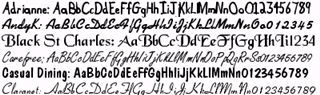
When deciding on what the fonts used within the opening sequence would be, we had to think about where the fonts would actually be used themselves. Instead of taking time to find a font appropriate for both the natural and the unnatural environments within the opening, we decided that the opening credits would be incorporated into the environment somehow, like how the student opening Buckets of Dead Friends writes the title at the end in the blood of the guy who gets shot. For example, in a tribute to a shot in American Psycho, a bottle of pills with the actors names on could be on screen for a couple of seconds.

This, of course, leaves us with determining the font for the title of the film at least. We decided that to keep in the tone of the film, set by the opening music and main character's general set-up, the font itself should be somewhat decorative or fancy, whilst potentially still having some dark feeling to it as a sign of madness. We couldn't find an appropriate font so we decided to just go with the fancy outlook, but then we came across Jellyka Castle's Queen, which seems to fit the bill perfectly, with the aspects we were looking for in a font from the start.


Font Name

Preview


Research
Colour Themes

Overall, since one of the scenes would be being shot in a natural environment (a field), the use of a colour palette seems somewhat unnatural, but eventually Tom and I came up with the idea that the two different environments - the opening field and the "kill room" - should have distinctly different colour palettes to further emphasize a contrast between the two, with the shots of travelling between the two being a progressive transformation from one palette to the next (mainly from a light palette to a dark palette).

First Colour Palette - "The Field"


For the field, we've chosen to use natural colours combined with the costume colours of the people involved (the victim and the person he's with) - the environment, obviously, would be blue and green or thereabouts, and the characters will be wearing fairly light colours, with the victim wearing a white shirt.

Second Colour Palette - "The Kill Room"


For the killing section, we've chosen to go with generally dark colours with implications akin to features of films in our genre - mainly the colour red, which is generally used to imply some presence of blood (and does so effectively in the opening for American Psycho), and the colour gray, generally used in a classic sense to show dark intentions. The purple used is to just be a darker version of the environment used before, suggesting that this environment is natural in it's own ways for the killer.

Research
Moodboards

At a couple of points during the film opening , knives and potentially a model gun will be used to some dramatic effect, to further emphasize any horror the man in the chair will be feeling at the point. And, you know, the bigger the knife the bigger the smile. Could be seen as a tribute to the likes of Scream, but I'd rather not associate this film opening with that one.
We also had to think about where the couple parts of the scene will be set. In the current storyboard, though very brief, the opening scene is of a field, and the following scene is within a car (hence the pictures), although afterwards the man is brought to a room which you generally only see the inside of. For filming purposes, the space would have to be fairly large, so a couple of the ideas are below for where it could be filmed.


The general feeling for the main character, supposedly the "bad guy", is drawing inspiration from various similar films and the like of the same (ish) genre. Overall, I think Christian Bale's portrayal of Patrick Bateman in American Psycho combined the perfect amount of co-ordination with the perfect amount of, simply put, crazy, and that would be a great thing to aim for with the main character. Sort of a combination between the forever classy Ron Burgundy in Anchorman, and the somewhat sinister yet equally ignorant Dexter (from, of course, Dexter).


The actual killing scene is generally going to be a tribute to the classic kill scene used in Dexter, in which an everyday room is covered in cling film, even the victim themselves before they wake up, and he puts up pictures of the people that the victim hurt in some way or another. However, one main difference in the film opening is that the "victim" isn't lying down, but is tied to a chair in the dark similar to the torture scene in Taken. Also, at one point the main character slams the door behind him, which I guess could be somewhat similar to the ending shot used in Saw.

Friday, 7 January 2011

Research
Film Title


When coming up with a title for the film opening, we decided to go with a generally classic feel, in order to match the atmosphere of the opening and the genre of the film overall. We decided in the end to go with the title...

'Guy de Vere'

Based on a character from one of Edgar Allan Poe's more famous poems 'Lenore', Guy de Vere is the fiance of the deceased Lenore who believes that someone shouldn't mourn the dead, but celebrate their passing instead. Overall, I think this fits rather nicely with the attitude of the main character, who seems to have no qualms with murder.

To get to this title however, we went through several names mainly derived from either Biblical quotes or poetry by Poe. These are the ones we were considering:

  • Stygian River - Again, based on 'Lenore', it references the river in Greek mythology that the dead must pass over in order to reach the Underworld.
  • "The Happiest Day" - Taken from a direct title of one of Poe's poems, we thought one of the lines in the poem were rather appropriate for the idea of the film ("The visions of my youth have been - but let them pass")
  • Generation of Vipers - A Biblical quote, it relates to the characters opinions on the people he kills (who are all a part of his past in some way), as well as linking to potential religious undertones of him
  • And various other titles that were just thought up out of the blue, and were more working titles than anything, such as Dirty Past, Blank Slate and The Killing (the last one being more of a reference to The Shining).

Film Pitch

Thursday, 6 January 2011

Research
Opening Credits


The opening credits are used to display the most important members of the production, including companies involved in things like the distribution and production, as well as the main actors and directors and the like.

This list is generally kept down to the most important members in order to have the opening more interesting for the audience - they'd probably be more interested in who wrote the screenplay and who the main actor is, for example, than who plays the janitor in the background of scene 5. This could also help in the event of a preview showing that doesn't show all of the main characters of the film, but are potential draws for people to come see the film.

Some films, however, deviate from this normal way of having opening credits - for example, No Country For Old Men has only the distribution companies mentioned in the opening title sequence, possibly to keep the audience thinking of the actors as the roles they're playing rather than the actors they are.

Research
No Country For Old Men Opening Sequence

Click the image to go to the video...
The sound used in the opening of No Country for Old Men is mainly diegetic, having the sounds of the car, the man talking, etcetera - the only non-diegetic sound used is the narration over the scene by the character Ed Tom Bell.

The shots used are also mainly long shots of the environment, at least whilst Ed is narrating. This part has the occasional close up however to introduce several elements, like the face of the policeman and the captive bolt pistol of Chigurh. The scene then relies on close ups of the action during and just before the strangling scene to focus the audience on the expressions of the characters – both fear in the policeman and the seemingly guilt-free expressions of Chigurh. These appropriately introduce the audience to the setting and the character of Chigurh, as well as the narration expressing the feelings of one of the protagonists, Ed Bell.

The credits, just like Dawn of the Dead, are kept to a black screen – though, surprisingly, the only credits that are given are those of the distribution companies (Miramax Films and Paramount Vintage), which keeps the audience focused on the events of the opening sequence rather than the credits.

Research
The Lost Boys Opening Sequence


Click the image to go to the video...

The opening sequence to the Lost Boys starts with a choir-like song playing over a long-shot of the sea, before settling on a fair ground. Overall, this does a pretty good job of setting the scene for the film, shortly after introducing the main antagonists of the movie (the group of vampires). The close ups on the vampires do an equally good job of expressing the confidence of the characters when confronted by the others (the security guard and the boyfriend). It also clearly shows who the leader of the group is (David, played by Kiefer Sutherland), thus setting up the interaction between the group and the protagonists of the film.
The transitioning between the shots is also very smooth, with the shots themselves being related to each other – the scene moves from the sea, to looking over the fair ground, to zooming into the fair ground, before resting on the scene with David’s gang on the carousel.
The credits are also, as usual, kept to non-distinct areas, and kept the theme of the clip – the credits are shown as the camera glides across the sea, and is coloured white like the reflection in the water, keeping to the general colour theme of the scene.

Research
Dawn of the Dead Opening Sequence


Click the image to go to the video...

The opening title sequence of Dawn of the Dead uses sounds both diegetic and non-diegetic, in the form of an interview with a state politician (?) and folk-y music in the latter half (though it also starts with deep tones, sort of like a siren). Overall, it keeps to both the theme of the movie, and sets it up rather well – the interview and clips relate to the terror felt throughout the film by the characters (and hopefully the audience) towards the infected, as well as the lack of knowledge everyone has about the virus. The music contrasts the gore-filled scenes, which emphasizes the horror in said scenes to the audience, making them more shocked when seeing them.
The majority, if not all, of the shots used within the opening are close ups and mid-shots, keeping the audience in the action of the clips, as well as in the perspective of the onlookers, such as in the case of the interview where the camera is clearly from the perspective of a camera man in the audience, and the shots angled down at a man in a hospital bed who’s clearly infected, coming from possibly the perspective of whoever’s treating them. The shots are mostly from camera’s of some sort that are in the fictional world of the movie – news cameras, handheld cameras, etcetera – keeping the audience immersed with it as it feels like watching various clips that the people themselves have made of the outbreak. The transitioning between the shots is also keep fast paced, mainly to mirror the pace of the scenes themselves and emphasize the terror felt by the onlookers as the infected attack.
The credits are, as usual, shown in non-distinct areas of the sequence, on black screens where nothing but the credits are shown in between the clips of interest. The credits themselves are also kept to theme of the clips, as they’re coloured red and made to look like blood as they’re wiped off of the screen (notably rather fast, keeping to the pace of the clips themselves).